
Explore 800+ Real Estate Projects in Bangalore
Discover newly launched apartments, villas, plots, and premium properties across Sarjapur Road and nearby locations.
Sarjapur Road did not become hot overnight. This is a corridor that spent years being ignored while Whitefield and Koramangala soaked up all the attention. But that quiet phase is what set it up for what is now one of the sharpest property appreciation runs in Bangalore’s recent history.
From 2019 to early 2026, prices on Sarjapur Road moved from roughly Rs. 5,870 per sq ft to over Rs. 12,000 per sq ft in many pockets.
That is a jump of more than 100% in seven years, with the steepest climb happening between 2021 and 2024 when the area clocked close to 63-73% appreciation in just three years. By comparison, the broader Bangalore market grew at around 6-9% annually. Sarjapur Road nearly tripled that pace.
Strategic Location & Seamless Connectivity
One of the biggest advantages of Sarjapur Road is its strategic location. It connects key employment hubs such as Electronic City, Whitefield, and the Outer Ring Road corridor. This makes daily commuting easier for IT professionals working in major tech parks.
Additionally, the upcoming metro expansion and road-widening projects are set to further improve connectivity. Once completed, these developments will significantly reduce travel time and enhance overall accessibility, directly impacting property demand and prices.
Thriving IT Ecosystem Driving Demand
Sarjapur Road has become a preferred residential hub due to its proximity to leading IT parks such as RGA Tech Park and Wipro SEZ. Thousands of professionals working in these hubs prefer living close to their workplaces, creating consistent demand for quality housing.
As Bangalore continues to grow as India’s tech capital, this demand is expected to rise steadily between 2026 and 2030. This makes Sarjapur Road a high-potential investment corridor with strong rental income opportunities.
So what actually drove this? And more importantly, is there still room left to grow between now and 2030?
The IT demand story is structural, not cyclical
Every real estate narrative about Sarjapur Road mentions IT proximity. But it is worth understanding exactly how tight this connection is.
Wipro’s headquarters, RGA Tech Park, RMZ EcoWorld, Embassy Tech Village, and Cessna Business Park all sit within or immediately adjacent to this corridor. Add to this the Outer Ring Road junction, which is the most IT-dense employment node in Bangalore’s eastern arc. Companies like Infosys, Microsoft, JP Morgan, and Goldman Sachs all have offices accessible within 20-35 minutes from most parts of Sarjapur Road.
Over 60% of homebuyers in this corridor today are IT professionals, and most are buying for end-use rather than speculation. That is a healthy demand signal. Speculative markets collapse. End-use markets hold. Bangalore’s IT workforce crossed 1.8 million professionals in 2025-26, and a significant chunk of that workforce cannot afford to live in Whitefield or Koramangala anymore. Sarjapur Road is where they land.
Return-to-office mandates across major tech companies in 2024-25 tightened the rental market further, pushing rents up 8-12% year on year. That alone has kept buying sentiment strong. People want to live close to where they actually have to show up every day.
If you are evaluating any project on this corridor, the residential project listings on Sarjapur Road reflect this demand reality very clearly. The configurations selling fastest are 2 BHK and 3 BHK, with professionals prioritising location over floor space.
The rental math right now
Rental yields on Sarjapur Road currently sit between 3.5% and 5.2%, which is among the strongest in Bangalore for residential assets. Here is what that looks like in actual numbers today:
A 2 BHK on Sarjapur Road fetches between Rs. 35,000 and Rs. 40,000 per month. A 3 BHK pulls Rs. 55,000 to Rs. 65,000. Premium 4 BHK units in gated communities are seeing Rs. 75,000 to Rs. 80,000 per month.
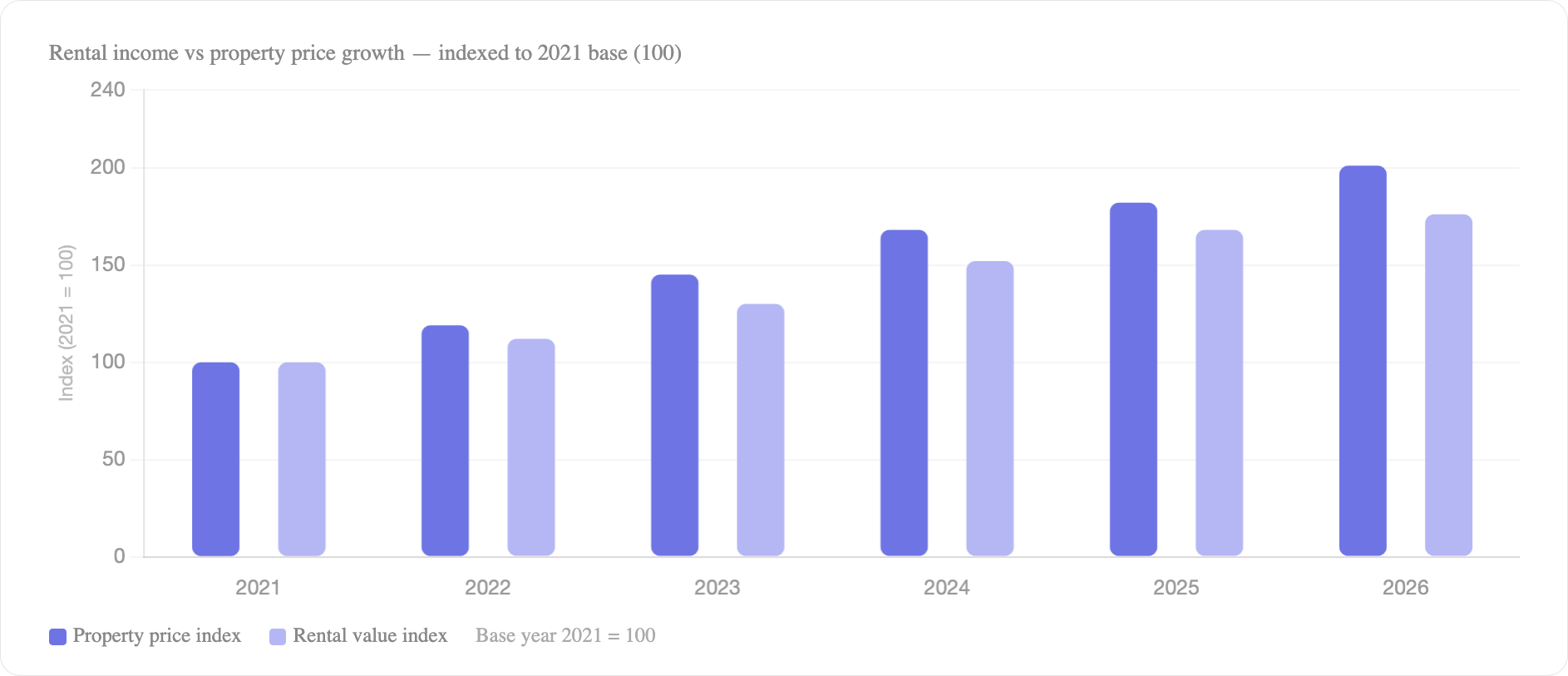
Average monthly rents jumped 76% between 2021 and 2025, moving from around Rs. 21,000 to Rs. 36,900 at the corridor average. That kind of rental growth alongside property appreciation is rare. You usually get one or the other. Sarjapur Road delivered both.
The Road Ahead For Sarjapur Road
Here is where the 2026-2030 case gets genuinely interesting. Most of the appreciation so far happened without metro connectivity. Sarjapur Road has been growing entirely on road access and employment density. The infrastructure that would normally be the biggest value catalyst is still incoming.
Three projects matter the most:
The Namma Metro Phase 3A
The Namma Metro Phase 3A corridor, the Sarjapur-Hebbal Red Line, was approved by Karnataka’s Cabinet in December 2024. It is 37 km long, covers 28 stations, and passes through Carmelaram, Agara, Koramangala, and Central Bangalore. The estimated project cost is Rs. 28,405 crore.
Central Government approval was pending as of early 2026, with construction expected to begin in 2027 and completion targeted around 2033. Globally, properties within 500m to 1 km of a metro station appreciate 15-25% faster than the corridor average in the 3-5 years before the station opens. That pre-opening window is now.
The Peripheral Ring Road
The Peripheral Ring Road (PRR) is a 116 km expressway that connects Tumakuru Road to Hosur Road and passes directly through Sarjapur Road. Once operational, it significantly cuts travel time to the airport and to North Bangalore, which today feels like a different city. Segments are expected by end-2025 through 2026.
SWIFT City
SWIFT City is the third piece. A planned 1,000-acre innovation and tech district near Sarjapur, positioned to be Karnataka’s third major industrial hub. If this comes together as designed, it adds a brand new employment node practically at the doorstep of the corridor.
The project is still in development phases, but early-stage planning has already moved land pricing in adjacent pockets.
How Sarjapur Road compares to the alternatives
Whitefield is the obvious comparison. It has an operational metro now and more mature infrastructure. But average prices in Whitefield are running meaningfully higher, and the growth potential from current levels is more compressed. Sarjapur Road currently offers a 20-35% discount versus comparable ORR belt locations while sitting 10-20 minutes away.
Electronic City is more affordable but farther from Central Bangalore and the ORR employment core. Hebbal has strong fundamentals but limited new supply. Sarjapur Road is the one corridor where a buyer gets family infrastructure, IT proximity, and pricing that still has room to move.
The 5-year appreciation figure from 99acres data puts Sarjapur Road flat prices up 113.2%. The 10-year figure is 189.3%. Over the last 3 years alone, it clocked 84-89%, which is exceptional even by Bangalore’s historically strong standards.
Rental growth vs property price growth
The chart below shows how rental values have tracked alongside property prices, which is the real test of whether market growth is healthy.
Wide Range of Residential Options
Another reason for Sarjapur Road’s popularity is the diversity of housing options. From affordable 2 BHK apartments to premium 3 and 4 BHK luxury homes, the area caters to a wide range of buyers.
Top developers have launched large-scale township projects and gated communities with world-class amenities. Projects like Godrej Lakeside Orchard, Adarsh Tropica Phase 2, Sobha Sacred Grove By The Lake, Godrej Sarjapur Road, and Assetz Trees & Tandem reflect the shift toward premium, lifestyle-oriented living.
These projects offer modern amenities such as clubhouses, green spaces, fitness centers, and smart home features, attracting both end-users and investors.
What buyers and investors should watch for
Not every pocket on Sarjapur Road is the same. Dommasandra and Kodathi have seen a high volume of new launches, and while demand is healthy, oversupply in specific micro-markets could moderate appreciation in those stretches near-term. Projects closer to ORR access points and IT parks will continue to outperform.
Two risks are worth flagging honestly. Traffic congestion at the ORR-Sarjapur junction and the Wipro junction remains a real daily problem. During peak hours, travelling 3 km can take 40+ minutes.
Road widening is ongoing, but completion timelines on infrastructure projects in Bangalore have historically been optimistic. The metro, once operational, will change this significantly, but that is a 2030-2033 story.
Water supply is the second watch point. Several pockets along the corridor still depend on borewells and water tankers rather than BWSSB municipal connections. This is a project-specific factor that any serious buyer should verify upfront. Checking RERA registration and project approvals before committing is essential here.