Explore 800+ Real Estate Projects in Bangalore
Discover newly launched apartments, villas, plots, and premium properties across Sarjapur Road and nearby locations.
Bangalore and Dubai are the two property markets every Indian investor is watching in 2027. One is India’s fastest-growing tech corridor.
The other is the world’s most talked-about tax-free property market. Both have nearly doubled in five to six years. But they got there in very different ways, and they do very different jobs for your money.
This article compares the two markets on the numbers that matter: price per sq ft, growth, rental yield, entry cost, taxes and visa. On the Bangalore side, every project price comes from Sarjapur Road Projects, the live listings on this site. On the Dubai side, every price comes from Dubai Land Department transaction data and the QoJo Media report on Emaar’s Palmiera Collective.
Bangalore vs Dubai at a Glance
| Sarjapur Road, Bangalore | Dubai | |
|---|---|---|
| Average price per sq ft | Rs 12,000 – Rs 13,000 | Rs 41,300 (median) – Rs 47,800 (average) |
| 1-year price growth | +15.7% | +8.8% (2025) |
| 5-6 year price growth | +98% (5 years) | +94% (since 2020) |
| Gross rental yield | 3.5% – 4.5% | About 6.3% |
| Cheapest entry | Rs 24.69 lakh | About Rs 84 lakh (AED 350,000 studio) |
| Most expensive in this comparison | Rs 8.54 crore | Rs 39.6 crore (AED 16.5 million villa) |
| Income tax on rent | Yes, as per Indian slabs | Zero |
| Capital gains tax | Yes | Zero |
| Visa on property purchase | No | 10-year Golden Visa at AED 2 million (about Rs 4.8 crore) |
The short version: Sarjapur Road is far cheaper to enter and has grown faster in the last five years. Dubai earns more rent and keeps more of it, because there is no income tax and no capital gains tax. The rest of this article shows the working behind each row.
Price per Sq Ft: Dubai Costs About 3 Times Sarjapur Road
The average apartment on Sarjapur Road costs Rs 12,000 to Rs 13,000 per sq ft in 2026, based on listing and registration data. Premium branded projects on the main road go up to Rs 14,500 per sq ft, while the far Attibele end starts near Rs 8,000 per sq ft.
Dubai’s median is AED 1,722 per sq ft across all sales registered with the Dubai Land Department in the 12 months to November 2026, which is about Rs 41,300 per sq ft at AED 1 = Rs 24. The average is higher, AED 1,992 per sq ft, about Rs 47,800. Downtown Dubai is the most expensive mainstream area at AED 3,343 per sq ft, about Rs 80,200.
That makes Dubai roughly 3.3 times more expensive than Sarjapur Road per sq ft. The gap is the whole story for a buyer with a fixed budget, and it is why the “what Rs 1 crore buys” comparison later in this article is so lopsided.
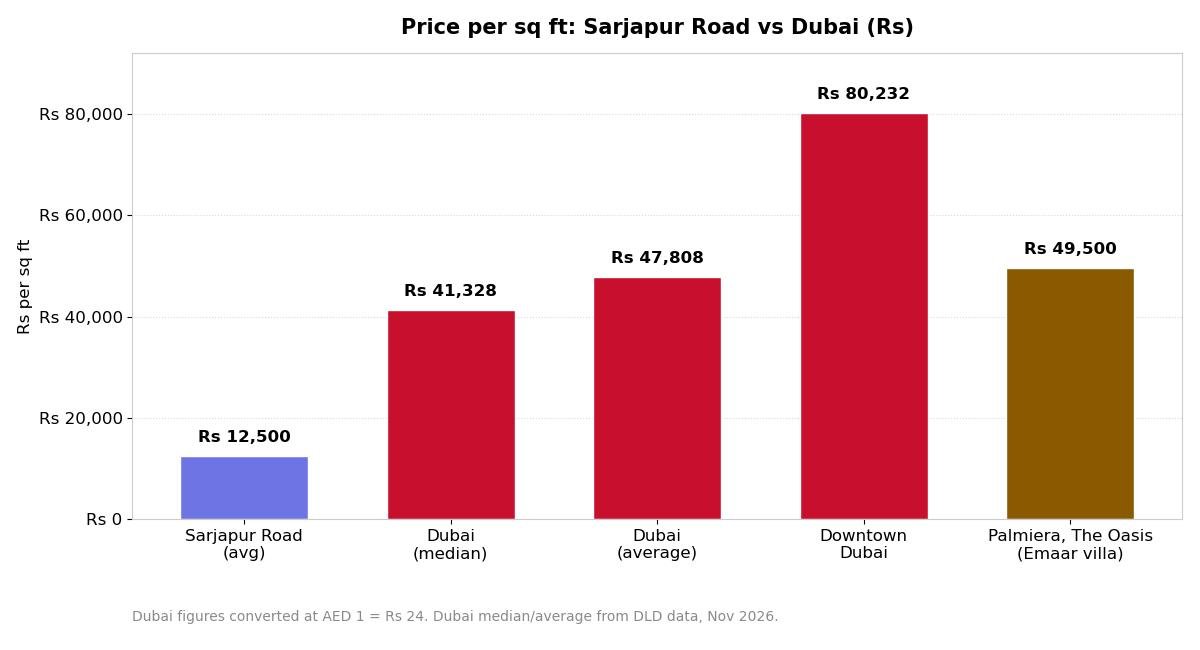
One detail worth noting: Emaar’s Palmiera Collective villa at The Oasis launched at AED 16.5 million for about 8,000 sq ft, which works out to about AED 2,060 per sq ft, or Rs 49,500. That is only slightly above Dubai’s citywide average.
The villa costs Rs 39.6 crore not because it is expensive per sq ft, but because it is 8,000 sq ft of villa. Size, not rate, is what makes Dubai’s top end so costly.
Growth: Sarjapur Road Grew Faster, but Both Markets Are Cooling
Sarjapur Road has the stronger recent growth record. Flat prices on the corridor rose about 15.7% in the last year, 84% to 89% over three years, about 98% over five years, and 185% to 189% over ten years. The average rate climbed from roughly Rs 6,050 per sq ft in 2021 to Rs 12,000 per sq ft by early 2026.
Dubai’s run has been longer but is now slower. Prices rose 26.9% in 2022, the peak year, then 8.8% in 2025 and 7.4% in the first two months of 2026. The compound growth rate from 2020 to 2026 is 11.7% a year, and prices are up about 94% since the 2020 trough. The median price per sq ft has nearly doubled from AED 872 in early 2020 to AED 1,722 in late 2026.
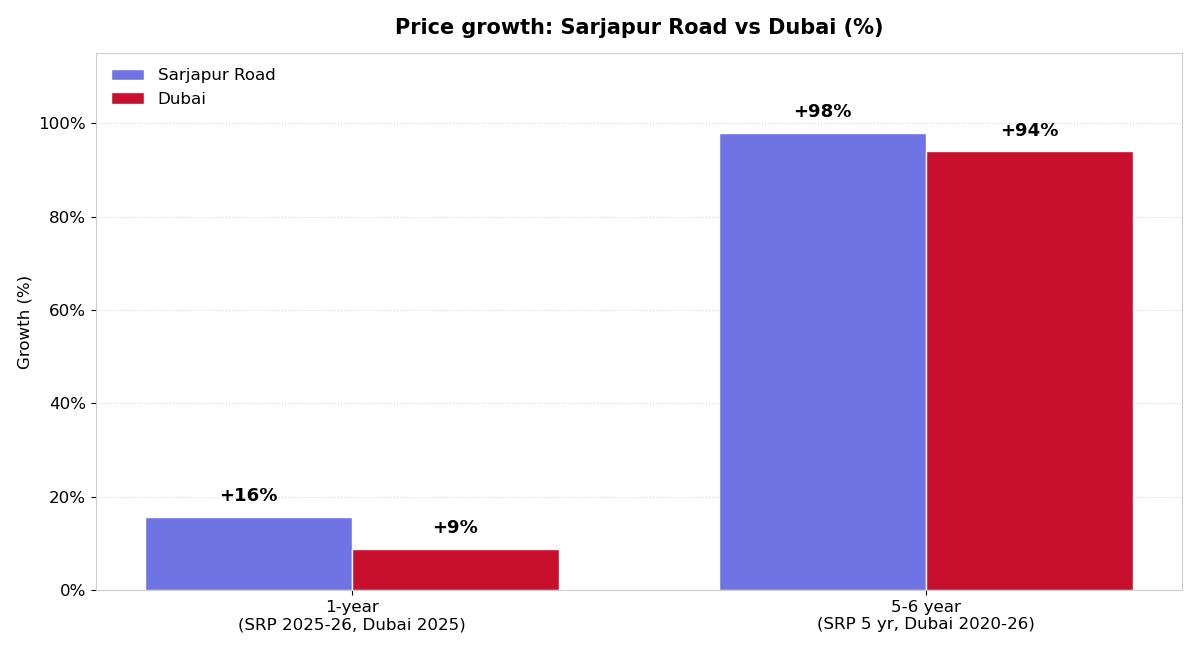
Here is the honest part both markets share: the surge is spent. On Sarjapur Road, 2026 is a consolidation year, with market trackers forecasting 4% to 8% a year through 2030, not another 15%. In Dubai, Knight Frank forecast prime price growth of about 3% and mainstream growth of about 1% for 2026, with up to 160,000 new units in the pipeline. Dubai’s average price per sq ft already eased from a peak of AED 2,093 in April 2026 to AED 1,830 in September 2026.
So if you buy the last five years’ growth as a forecast, you will be disappointed in both markets. The growth question for 2027 is not which market grew faster, it is which market still has room to grow from here.
Sarjapur Road’s case rests on the metro and the Outer Ring Road job market. Dubai’s case rests on population growth and the Golden Visa pulling in buyers. Neither is a sure thing.
Highest vs Lowest Value Projects on Sarjapur Road
Sarjapur Road Projects lists 137 projects, from Rs 24.69 lakh to Rs 8.54 crore. That is a 35 times spread on a single road, and it is the widest range of any Bangalore corridor we track.
The highest: Sobha Crystal Meadows, Rs 8.54 crore
The most expensive project on Sarjapur Road is Sobha Crystal Meadows in Mullur, a collection of 4 BHK luxury row house villas by Sobha Limited, starting at Rs 8.54 crore. It is the top of the corridor’s luxury villa market, and it sits about 35 times above the cheapest project on the same road.
Sobha Crystal Meadows | Rs 8.54 Cr onwards | 4 BHK luxury row house villas, Mullur, Sarjapur Road
The second highest: Nambiar Bellezea Next Phase, Rs 7.07 crore
Next is Nambiar Bellezea’s next phase in Kaggalipura, offering 4 BHK villas from Rs 7.07 crore, followed by Nambiar Ellegenza Phase 2 in Muthanallur at Rs 5.22 crore and Bandu Eco Crest near Wipro at Rs 5.13 crore. The top four projects on the road are all luxury villas above Rs 5 crore. For the tier just below, see the best villas in the Rs 3 to 4 crore range on Sarjapur Road.
Nambiar Bellezea Next Phase | Rs 7.07 Cr onwards | 4 BHK villas, Kaggalipura, Sarjapur Road
The lowest: Soul Tree by Modern Spaaces, Rs 24.69 lakh
The cheapest project on Sarjapur Road is Soul Tree by Modern Spaaces, offering 1, 2 and 3 BHK apartments across 5.5 acres with 564 units, starting at Rs 24.69 lakh.
That is a 1 BHK entry point on the same corridor where a luxury villa costs Rs 8.54 crore. The next cheapest are KNS Laurel Plots at Rs 60 lakh and DS Max Sahara, a 2 BHK apartment project in Chikkanagamangala, also at Rs 60 lakh.
Soul Tree by Modern Spaaces | Rs 24.69 Lakh onwards | 1, 2 and 3 BHK apartments, Sarjapur Road
The growth point is simple: the whole corridor rose about 98% in five years, so both ends rode the same wave. The entry-level projects are where the percentage growth was steepest, because they started from a low base. The luxury villas are where the absolute rupee gains are biggest.
A villa that rose 98% from Rs 4.3 crore to Rs 8.54 crore gained Rs 4.2 crore. An apartment that rose 98% from Rs 12.5 lakh to Rs 24.69 lakh gained Rs 12 lakh. Same percentage, very different money.
Highest vs Lowest in Dubai
The highest: Palmiera Collective, The Oasis, AED 16.5 million (about Rs 39.6 crore)
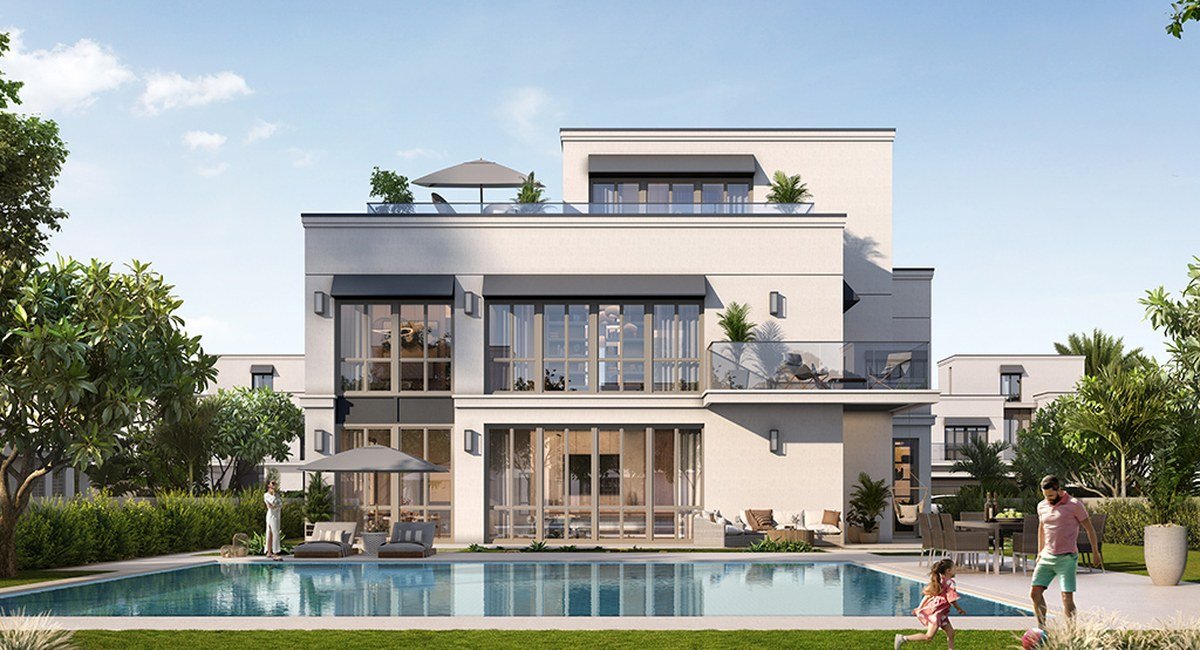
Dubai’s top end in this comparison is Palmiera Collective, a cluster of just 38 four-bedroom villas at the western tip of The Oasis by Emaar. The villas launched in early 2026 at AED 16.5 million, about Rs 39.6 crore, on an 80/20 payment plan with handover due in February 2029.
Each villa is about 7,900 to 8,100 sq ft on a plot of about 8,500 to 8,900 sq ft, and every villa faces water, with the community’s lagoons and canals running through the cluster. It is the most exclusive release by unit count in Emaar’s 100 million sq ft waterfront community.
Dubai Land Department records show 25 sales registered since February 2026, with no resales yet.
An October 2026 registered sale put a 7,880 sq ft villa at AED 16.2 million, close to the launch price, while current listings start at about AED 17.9 million. Read the full report on Palmiera Collective, Emaar’s 38-villa waterfront cluster at The Oasis in Dubai.
The lowest: International City studio, from about AED 350,000 (about Rs 84 lakh)
Dubai’s cheapest entry is a studio in International City, starting from about AED 350,000, about Rs 84 lakh. The median one-bedroom in International City Phase 1 is AED 465,000, about Rs 1.12 crore.
Jumeirah Village Circle, the mid-market favourite, starts higher: studios from AED 450,000 to AED 550,000, about Rs 1.08 crore to Rs 1.32 crore, with a one-bedroom median of AED 1.12 million, about Rs 2.68 crore.
The spread in Dubai runs from about AED 350,000 to AED 16.5 million, roughly 47 times. That is wider than Sarjapur Road’s 35 times, because Dubai’s top end goes much higher in absolute rupees.
What Rs 1 Crore Buys in Each Market
Rs 1 crore is about AED 417,000. Here is what it buys.
| Rs 1 crore buys | Sarjapur Road, Bangalore | Dubai |
|---|---|---|
| What you get | A 2 BHK apartment, or a 3 BHK in the outer pockets | A studio in International City, Dubai’s cheapest community |
| Example | DS Max Sahara 2 BHK from Rs 60 lakh; Soul Tree 1, 2 and 3 BHK from Rs 24.69 lakh | International City studio from AED 350,000 (about Rs 84 lakh) |
| What it does not buy | It does not buy a luxury villa, those start above Rs 5 crore | It does not buy a 1 BHK in JVC (median AED 1.12 million, about Rs 2.68 crore) or anywhere near Downtown |
| Size | About 1,000 to 1,200 sq ft | About 350 to 520 sq ft |
Rs 1 crore buys a family home on Sarjapur Road and a studio in Dubai’s cheapest community. That is the clearest single comparison in this article, and it is why the entry-level buyer belongs in Bangalore, not Dubai.
Rental Yield: Dubai Wins Clearly
If growth is Sarjapur Road’s strength, rental yield is Dubai’s. Dubai’s average gross rental yield was 6.26% in September 2026, and about 6.6% across 2026 by another measure.
Jumeirah Village Circle yields 6.3% to 7.3%, Dubai Marina 5.5% to 5.7%, and Downtown 5.1% to 5.7%. International City studios yield 8% to 9% and more, which is why they are the first pick for pure yield investors.
Sarjapur Road yields 3.5% to 4.5% for a gated 3 BHK, and up to 5.5% for a compact unit near the Outer Ring Road. That is a normal Bangalore yield, and it is about two-thirds of Dubai’s average.
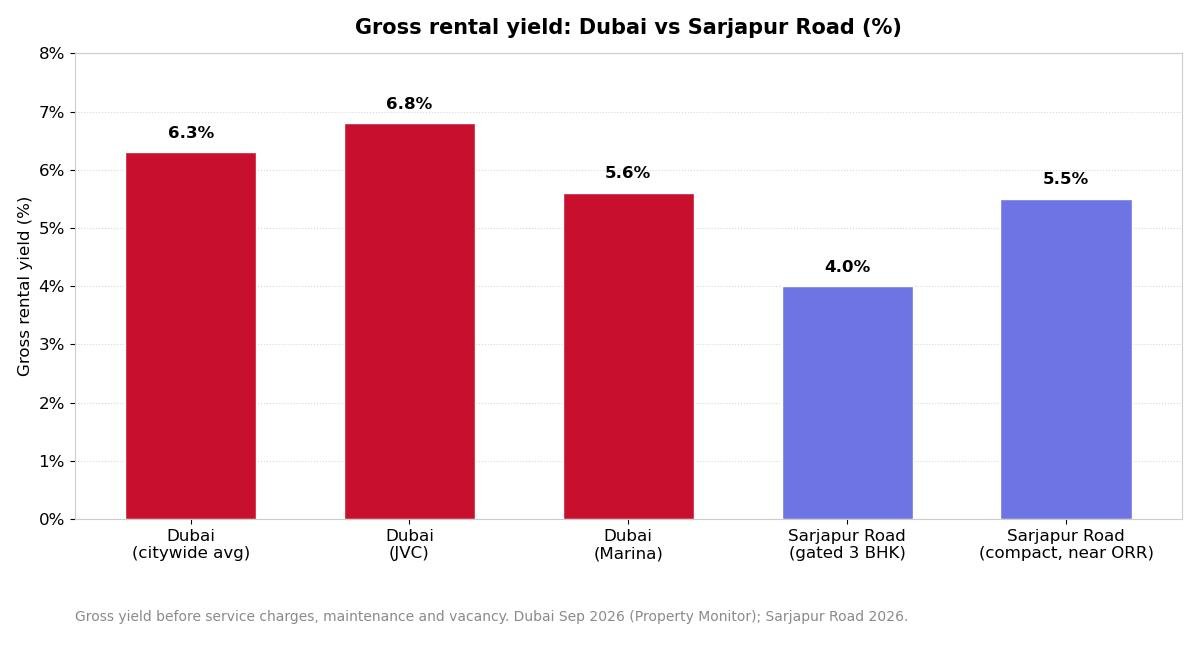
Two cautions. First, these are gross yields, before service charges, maintenance and vacancy. Dubai’s service charges are high, especially in prime towers, so the net yield is lower than 6.3%. Second, a high yield in International City comes with lower capital growth and lower liquidity than a mid-market community. Yield alone is not a buy signal.
Taxes and Visa: Dubai’s Real Edge
Dubai charges zero personal income tax and zero capital gains tax on property. There is no annual property tax either, only a 4% Dubai Land Department transfer fee on purchase and service charges after that.
A Rs 1 crore property earning 6.3% gross in Dubai keeps far more of its rent than the same property in Bangalore, where the rent is taxed at Indian slab rates and the sale is taxed as capital gains.
Dubai also gives a 10-year Golden Visa for a property investment of AED 2 million, about Rs 4.8 crore. That is the price of a luxury villa on Sarjapur Road, and it buys residency in the UAE, not just a property. India offers no visa benefit for buying property.
On the other side, buying in Bangalore costs about 7.6% extra in stamp duty and registration in Karnataka, on top of the property price. Dubai’s 4% transfer fee is lower. But the Indian buyer also gets a home in rupees, in a market they understand, with no currency risk on the rent. A Dubai property earns in dirhams and costs in dirhams, so the rupee return depends on the exchange rate as well as the property.
The Verdict: Where Is Your Money Growing Faster in 2027?
On the growth record, Sarjapur Road wins. It rose 15.7% in the last year and 98% in five years, against Dubai’s 8.8% in 2025 and 94% since 2020. It also wins on entry: Rs 24.69 lakh gets you into Sarjapur Road, while Dubai’s cheapest studio costs about Rs 84 lakh. And Rs 1 crore buys a 2 BHK on Sarjapur Road against a studio in Dubai’s cheapest community.
On income, Dubai wins. A 6.3% gross yield against 4%, with zero income tax and zero capital gains tax, means the same money earns more and keeps more in Dubai. On visa, Dubai wins outright, with a 10-year Golden Visa at AED 2 million.
So the answer depends on what you want the money to do. If you want growth and you have Rs 25 lakh to Rs 1 crore, Sarjapur Road is where your money has grown faster, and it is where your budget buys a real home.
If you want rental income, tax-free returns and a visa, and you have Rs 1 crore or more, ideally Rs 4.8 crore for the Golden Visa, Dubai is the better income play.
The two markets are not substitutes. They do different jobs. The smartest buyers we see do not pick one, they use Sarjapur Road for growth on a lower budget and Dubai for yield and residency on a higher one. But if you have to pick one market with Rs 1 crore in 2027, Sarjapur Road gives you more home and more recent growth for the money.
Frequently Asked Questions
Which market grew faster, Bangalore or Dubai?
Sarjapur Road in Bangalore grew faster recently. It rose about 15.7% in the last year and about 98% over five years. Dubai rose 8.8% in 2025 and about 94% since 2020. Both markets are cooling into single-digit growth in 2026, so neither past rate is a forecast for 2027.
What is the average price per sq ft on Sarjapur Road vs Dubai?
Sarjapur Road averages Rs 12,000 to Rs 13,000 per sq ft in 2026. Dubai’s median is AED 1,722 per sq ft, about Rs 41,300, and the average is AED 1,992 per sq ft, about Rs 47,800. Dubai is roughly 3.3 times more expensive per sq ft.
What is the rental yield in Dubai vs Bangalore?
Dubai’s average gross rental yield is about 6.3%, with Jumeirah Village Circle at 6.3% to 7.3% and Dubai Marina at 5.5% to 5.7%. Sarjapur Road yields 3.5% to 4.5% for a gated 3 BHK, and up to 5.5% for a compact unit near the Outer Ring Road. These are gross yields, before service charges, maintenance and vacancy.
Can an NRI buy property in Dubai?
Yes. Foreigners can buy freehold property in Dubai’s designated freehold areas, including International City, Jumeirah Village Circle, Dubai Marina and Downtown. A property investment of AED 2 million, about Rs 4.8 crore, qualifies for a 10-year Golden Visa.
What does Rs 1 crore buy in Dubai vs Sarjapur Road?
Rs 1 crore, about AED 417,000, buys a 2 BHK apartment on Sarjapur Road, for example DS Max Sahara from Rs 60 lakh, or a 3 BHK in the outer pockets. In Dubai it buys a studio in International City, the cheapest community, from about AED 350,000. It does not buy a 1 BHK in Jumeirah Village Circle, where the median is AED 1.12 million.
Is it better to invest in Sarjapur Road or Dubai in 2027?
For growth on a budget up to Rs 1 crore, Sarjapur Road has the stronger recent record and buys a real home. For rental income, tax-free returns and a visa, with Rs 1 crore or more, Dubai is the better income play. The two markets do different jobs, and the choice depends on whether you want growth or income.